
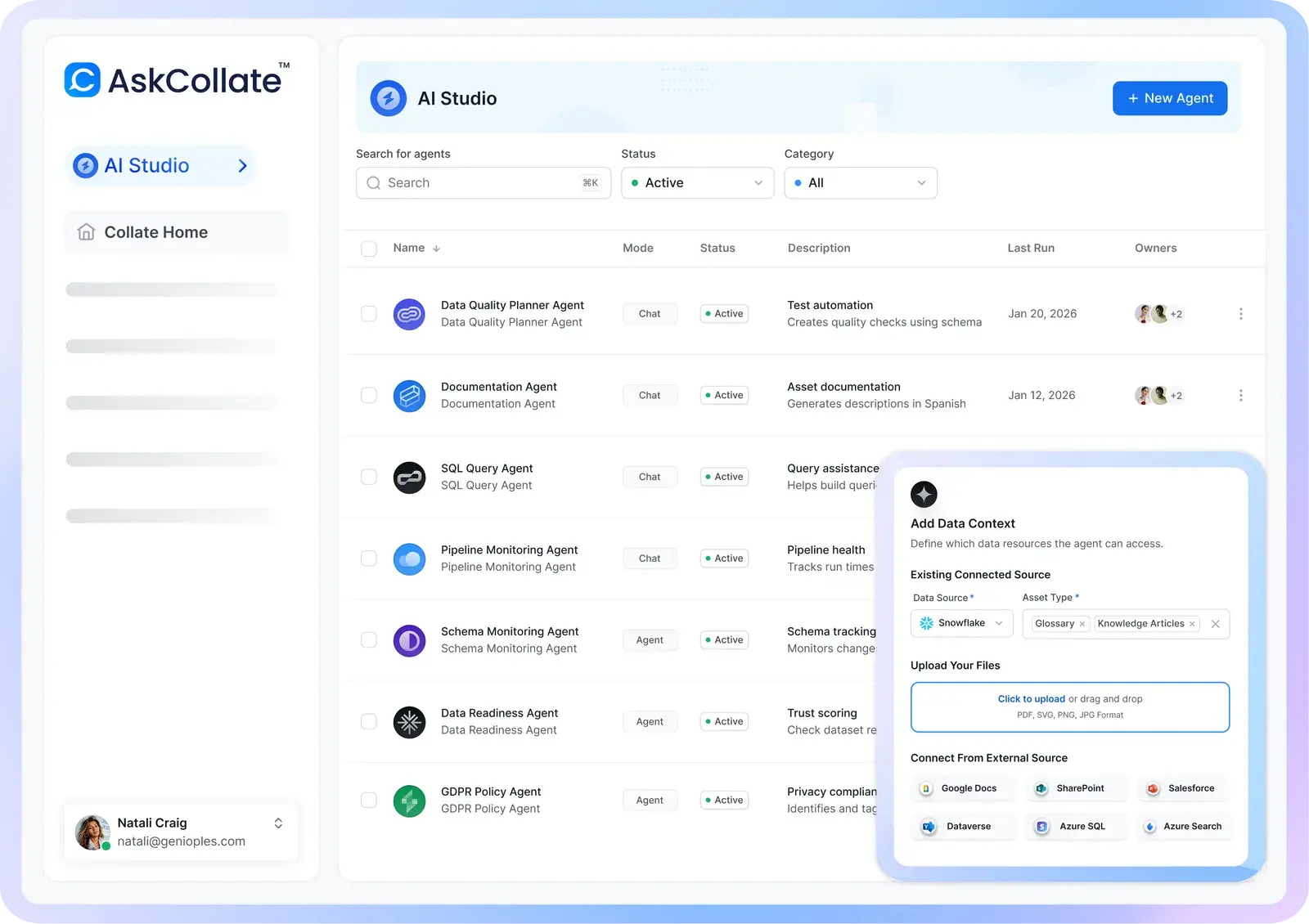


Fast AI agent creation
Easily build agents with simple AI prompts to define tasks

Fine-tuned agent skills
Choose from a set of well-defined skills to enable task specialization and work accuracy

Data and business expertise
Leverage the Collate semantic metadata graph so agents understand your data and business context
Fast AI Agent Creation
Create agents in AI Studio. Put them to work through the Collate UI or via apps built on AI SDK
![[object Object]](/_next/image?url=%2Fimages%2Fai-studio%2Fagent.png&w=3840&q=75)
Fine-tuned AI agent skills
Specialize agent skills with a persona and specific capabilities to accurately direct the AI
![[object Object]](/_next/image?url=%2Fimages%2Fai-studio%2Fagent-skills.png&w=3840&q=75)
Data and business expertise
Agents understand the semantics captured in the platform to take action on the right data
![[object Object]](/_next/image?url=%2Fimages%2Fai-studio%2Fdata-business.png&w=3840&q=75)
Built for modern data & AI practices
Designed for changing needs of data & AI teams
AI-Driven Automation
Improve productivity, enforce governance and reduce costs with AI driven automation
Unified Platform
One platform for all your teams for data discovery, observability and governance
Collaborate Around Data
Accelerate development of data assets with social workspaces and knowledge centers
Get started with Collate today for free
Get Collate FreeManaged Service for Production Data Teams
Book a DemoFAQs
Collate AI Studio is the no-code UI for building agents in Collate that perform data management tasks like tagging/documenting data, suggesting/creating/running data quality tests, tracing data lineage, finding PII, etc. AI Studio agents are self-contained so there are no external dependencies you have to set up.
Collate AI SDK is a software development kit for the Python, Java, and TypeScript languages that let you build agentic AI applications using the semantic metadata graph captured in Collate. AI SDK applications are easy to write because they call agents built with AI Studio, so all you need to pass is an AI prompt that defines the task to perform. No external technologies are needed to create and run AI SDK applications.
The Collate AI agent architecture is intended to drastically simplify the development of agents by creating a self-contained environment that does not require you to set up external technologies. With an MCP server integration, you need to write code to handle task orchestration, or add LangChain into the mix, which adds more complexity than necessary.
For AI Studio agents, you don’t need any special skills since they are created in an easy-to-use AI. You simply need to specify an AI prompt that defines the task to perform.
For AI SDK applications, you need to know how to develop applications in Python, Java, or TypeScript. No other technologies or specialized skills are needed.
AI Studio and AI SDK are designed to handle a wide range of data management tasks. If you can do it in the UI, you can create an agent to automate it for you. For example:
- Identify and tag every table containing patient health information as part of HIPAA
- Monitor tier 1 tables daily, and automatically create data quality tests whenever schemas change or new tables are added
- Check if pipelines are running on time and without failures
- Check if we are catching schema drifts before problems arise
- Verify that we are inline with the company’s GDPR policy
- Creates quick summaries on data readiness, especially on whether a dataset is trustworthy and ready for AI or analytics use, and how it has been used by others
AI Studio and AI SDK were designed to be complete, self-contained agent frameworks that do not need external technologies. Unlike other agent frameworks that require external technologies to build robust applications, Collate agents were designed to be easy to build and run. However, if you want to include other technologies like LangChain and MCP servers, those are supported as well.
Agents on other platforms have a very limited understanding of data. They read metadata to categorize data, but they do not have deeper information through semantic ontologies (i.e., semantic intelligence) about relationships and meaning, leading to inaccurate results due to assumptions the AI makes.
With Collate, the unified semantic graph captures metadata and relationships between metadata and data sets (e.g., PII is related to GDPR, which is related to “compliance”) so the agents have a clearer understanding of data. All of the relationship information is captured in the platform and does not have to be explicitly called out in the tasks, making the agent definition process much easier for anyone, including those who are not data experts.