Build AI Agents That Understand Your Data and Business



If you’re not using AI agents to manage your data, then you’re spending way too much time on data management tasks. Think about it: is it a good use of your time spending 10-15 hours (or more) per week on manual tasks? Wouldn’t you and your colleagues be much more productive if you handed off these time-consuming tasks to AI? Let AI handle the heavy lifting for tagging and documenting your assets, building and running data quality tests, troubleshooting data errors, creating glossary terms, or even searching for data you can trust and use. AI can now do a great job in handling these repetitive, manual tasks for you and your teams.
That’s why we’re excited to announce the release of Collate AI Studio and Collate AI SDK, two easy yet powerful ways to build and use AI agents to perform data management tasks with speed, accuracy, and scale. AI Studio lets you build agents visually, while AI SDK lets you call those same agents from your custom applications. The agents leverage the semantic intelligence that underpins the Collate platform so they have a deep understanding of the data and business context they are taking action on. These new capabilities are part of Collate 1.12, the latest release from Collate, which lets data-driven enterprises use, customize, and build agents they want, the way they want.
Are you skeptical on whether AI is the right approach for data management? We understand your sentiment because we know that general-purpose AI tools on their own can't help. They don't understand your specific data landscape, your lineage, or your governance policies, so they need a lot of hand holding. Other technologies in the market don’t go nearly far enough in solving your growing data management workload.
This is where the semantic intelligence in Collate helps. Unlike generic AI tools that work from text alone, Collate's semantic metadata graph understands that a 'customer_id' in your orders table relates to 'user_id' in your CRM, enabling agents to understand context across your entire data landscape.
These capabilities build on the semantic intelligence foundation described by my co-founder and CEO, Suresh Srinivas, in his launch post. Without shared, machine-readable meaning across metadata, lineage, and governance, agents would have no reliable context to operate safely. AI Studio and AI SDK exist because that foundation is now in place.
How Collate Agents Work
Collate agents combine three capabilities:
-
Semantic Understanding - Your agent knows how tables, columns, dashboards, and business terms relate
-
Specialized Skills - Choose from Metadata Management, Data Quality and Testing, Discovery and Search, and more
-
Custom Instructions - Describe your task in plain English, just like prompting ChatGPT
The result? Agents that don't just follow scripts—they understand your data landscape and make intelligent decisions.
Collate AI Studio for No-Code Agents that Understand Your Data
Imagine building no-code agents that understand relationships and business meaning in your data. The machine-readable semantic metadata graph built into Collate gives your agents context and understanding so they can take the right action on the right data.
These aren't generic chatbots that simply look up answers. They leverage your shared enterprise knowledge captured by the Collate semantic metadata graph, so they understand data, dashboards, lineage, and business context. This results in accuracy that lets you trust the actions they take.
So instead of spending time performing repetitive, manual tasks, let your agents do all the heavy lifting. You get a huge productivity boost by building custom AI agents that automate your unique data workflows, without writing code.
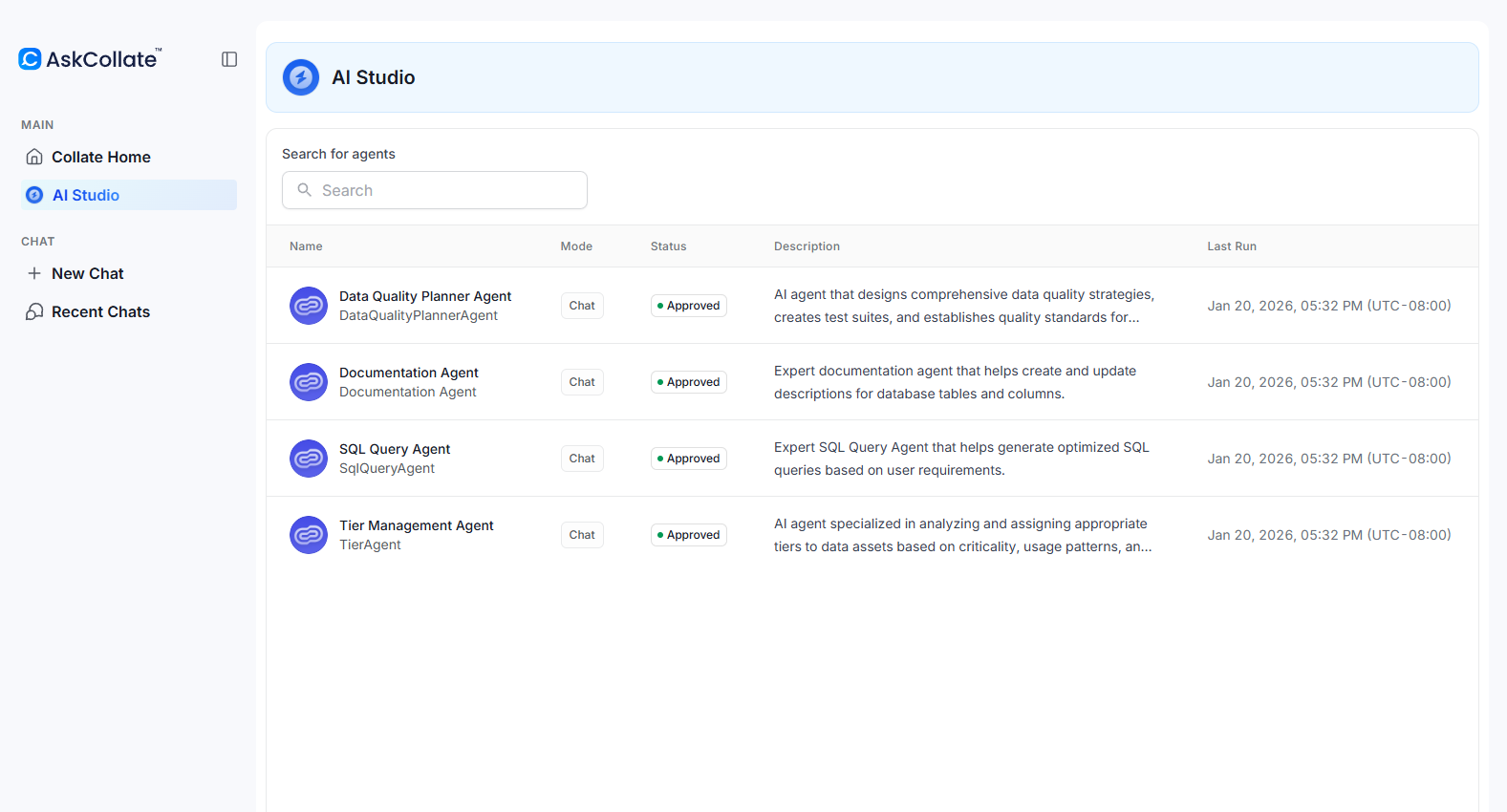
With AI Studio, agents are easy to build. You get a core set of agents that you can use as templates for your own custom agents, or you can build agents from scratch. Several of these agent workflows (such as documentation, tiering, and data quality planning) already existed in the Collate product. AI Studio now makes them tunable. Teams can modify prompts and configuration in the UI to adapt the agents to their data, policies, and operating workflows.You select a few parameters in the UI that provide specialized skills to your agent, and then you specify an AI prompt to define the task, just like you are using a chatbot. The agents run on-demand or on a schedule, and run either via the UI or called by your external AI application (on AI SDK, more on this below), so they run whenever they are needed, especially to keep your data ecosystem up to date.
Collate AI SDK for Agentic Applications
Use AI SDK to build custom agentic applications in Python, Java, or TypeScript. These applications call your agents built with AI Studio with a prompt to perform specific work. This means your agents leverage the semantic intelligence in the platform to fully understand your data. AI SDK provides everything you need to build and run AI applications–no infrastructure build-out, no integrations, no complexity. It’s all contained in the Collate environment and gives you the freedom to do even more in your agentic applications. For example, you might delete specific records as requested by a customer or partner, or add comments to a GitHub repo, or even run a real-time ETL/ELT pipeline that refreshes dashboard tables every hour.
With AI SDK, we’ll provide you the API and the intelligence on your data, and you take over from there. And since AI Studio and AI SDK are designed to be self-contained agent frameworks, there are no other external technologies you need to integrate. That makes Collate agents much easier to develop and run than in other agent frameworks. Of course, if you want to integrate other technologies like tools via an MCP server integration, or LangChain, those are certainly supported as well.
Making Collate Agents Work for You
Let’s walk through some examples of how Collate agents can help different roles in your enterprise.
Data Steward
First, let’s see what a data steward at a healthcare company preparing for a compliance audit would do. You need to identify and tag every table containing patient health information as part of HIPAA across your entire data warehouse.
Instead of taking weeks exploring tables, reviewing schemas, and discussing with engineers, you can let agents help. The steps are easy:
-
Open the agent building UI in Collate and name your agent (let’s call it the “HIPAA Compliance Agent”).
-
Assign it a Data Steward persona focused on governance.
-
Select Metadata Management and Discovery & Search as specialized capabilities.
-
Then describe the task in natural language as:
"Scan all tables for columns that contain protected health information including patient names, medical record numbers, diagnoses, and treatment data. Tag identified tables with 'PII' and 'PHI' tags. Flag tables for my review if you're uncertain."
Schedule the agent to run weekly. Now, as new tables are created, they're automatically scanned and tagged. What was weeks of manual work becomes continuous, automated compliance monitoring.
Data Engineer
Now let’s explore what a data engineer might do with Collate agents. Let’s say you manage a data platform that serves over 50 teams. Each team has different data quality requirements, but manual test creation can’t keep up with new tables being added daily.
Similar to the example above, you set the persona (in this case, Data Engineer), select Data Quality & Testing and Data Lineage & Exploration capabilities, then describe the task as:
"Monitor all Tier 1 tables daily. When a table's schema changes or new tables are added to Tier 1, automatically create appropriate quality tests: uniqueness checks for ID columns, null checks for required fields, and range validation for numeric fields. Create tests based on the table's metadata and column names. Notify me in Slack when new tests are created."
When new tests are created, you review them in Slack and then approve them. Now you have a dramatically streamlined data quality testing workflow.
Data Leader
As a final example, what about a data leader of a team of 12 people supporting a company of 2000. Your team faces critical issues like, “are our pipelines running on time and without failures”, “are we catching schema drifts before problems arise“, “are we inline with the company’s GDPR policy”, and “are we able make our data team productive with the help of AI that relies on strong data”?
You automate the handling of these issues with a series of agents such as:
-
Pipeline Monitoring Agent: Checks that pipelines run on time and are error free
-
Schema Monitoring Agent: Checks to ensure schema changes do not create downstream issues with pipelines and data stores
-
GDPR Policy Agent: Verifies that all GDPR concerns are addressed to ensure compliance
-
Data Readiness Agent: Creates quick summaries on whether a dataset is trustworthy and ready for AI or analytics use, and how it has been used by others
Now your team is more proactive and less reactive. Engineers focus on architecture. Analysts spend time on insights, not hunting for data. And the business finally has self-service that actually works. Depending on the prior workload, customers might see results like the overall ticket volume down 40%, time-to-delivery for new dashboards cut in half, and data quality scores up 25%, all within 6 months, all with existing headcount.
Getting Started
Ready to see how Collate agents can transform your data team's productivity? Please schedule a demo to build your first agent with our team today.