
What Is Semantic Context
and Why It Matters
AI has delivered on its promise in some places and fallen short in others. One place it has genuinely worked is software engineering. Cursor, GitHub Copilot, and Claude Code transformed how developers work not because the models got smarter, but because code already lives inside a designed context system. Files have structure, dependencies are explicit, and decisions are reviewable. The model walks into a world an industry spent two decades building.
Data is where AI has yet to deliver. The data team's context system today is a hand-stitched assembly of tools that don't share a data model, a semantic layer, or an audit trail. Definitions drift and lineage breaks at system boundaries. When an AI agent walks into that landscape, it returns whichever answer it hits first. It is confident, fast, and plausible, which is the problem.
The missing foundation
A semantic context layer is the missing foundation. It encodes the shared, formalized knowledge of what data means across an organization: the definitions, relationships, and governance rules that allow both people and AI systems to work from the same interpretation of data, consistently and at scale.
 Schedule a demo
The New Expectations for AI
Over the past decade, organizations built strong metadata foundations: unified models, encoded relationships, lineage tracking, and governance frameworks. That work moved organizations from fragmented metadata toward unified graphs that enabled discovery, quality monitoring, and observability at scale.
The core context gap. Structure alone is not enough.
AI introduces a fundamental shift. Schemas, relationships, and glossaries describe data. They do not explain what it means, how concepts relate to each other across the business, or which definition applies in a given context. Those are precisely what AI requires to operate reliably, and precisely what metadata alone cannot provide. Structure is not understanding, and that gap is where AI breaks down.
Understanding Requires the Right Semantic Architecture
Without explicit definitions, AI models guess. Consider the question "what is revenue?" Finance defines it as net revenue, Sales defines it as gross revenue, and Marketing defines it as attributed revenue. All three share the same column name in the data warehouse. Without semantic context governing which definition applies, a large language model (LLM) selects its answer based on proximity and frequency, producing a confident but incorrect answer that looks plausible.
The instinct is to throw more context at the problem through richer descriptions, better tags, or more retrieval. But this misunderstands the failure. Language models generate statistical likelihoods of token sequences. Context retrieval through RAG surfaces relevant data but does not guarantee correct interpretation. This is the core limitation of RAG-based approaches applied to enterprise data. Prompt engineering guides a model toward an answer but cannot make that answer consistent when underlying definitions are ambiguous.
Think of a senior analyst who has worked at your company for five years. She knows where the data lives. She knows that when the CFO asks for revenue, he means net revenue excluding intercompany transactions, not the gross figure that shows up in the warehouse. And she remembers that the last time someone pulled the Q3 number from the marketing schema, it was wrong, and she corrected it. That knowledge took years to build and it lives entirely in her head.
AI walks in on day one, every time. Without a semantic layer encoding what revenue means and a memory layer capturing past corrections, it has no way to replicate what she knows. More retrieval does not solve this. It just gives the model more data to be confidently wrong about.


Probabilities ≠ Meaning
LLMs generate statistical likelihoods of token sequences. Meaning is a human construct that must be mapped to these outputs.

Recall ≠ Correctness
Context retrieval (RAG) brings relevant data to the surface, but doesn't guarantee the model interprets that data accurately.

Explicit modeling
Definitions and relationships must be explicitly modeled to ensure reliable reasoning and consistent interpretation.
Intelligence requires explicit semantic architecture, not just scale.
The missing ingredient is the semantic architecture, which is the structured knowledge layer that the model reads from before it ever generates a response. This is where business concepts are formally defined, relationships between concepts are explicitly encoded, and governance rules propagate automatically. That layer has to be designed deliberately. It cannot be improvised at runtime through prompting or retrieval.


From Metadata to a Semantic Context Layer
Making metadata machine-understandable required two fundamental evolutions. The first was moving from metadata structure in JSON schemas to RDF as a graph of subjects, predicates, and objects that machines can traverse, search, and reason over. The second evolution was moving from glossary to ontology, which models how concepts relate to each other.
Ontology vs. Glossary: Why the Distinction Matters
A glossary entry tells you what the word means. An ontology models customer as a node connected to domain, orders, metrics, and revenue, with each relationship explicit, governed, and traversable. An AI agent querying for customer lifetime value does not interpret the word. It traverses the graph to the governed metric definition and arrives at the correct answer.
A semantic context layer is related to but distinct from the semantic layer concept familiar to dbt and BI users. Where a semantic layer standardizes metric definitions for BI consumption, a semantic context layer operates at the level of meaning and governance across the entire data estate.


Context-driven systems
- Embeddings
- Vector similarity
- Prompt engineering
- Approximate matching
- Inconsistent results
- No guarantees

Semantics-driven systems
- Ontology
- Defined relationships
- Governed definitions
- Precise interpretation
- Consistency
- Explainability
This is the distinction between context-driven and semantics-driven systems. Context-driven systems rely on embeddings, vector similarity, and prompt engineering, producing approximate matching, inconsistent results, and no guarantees. Semantics-driven systems model concepts explicitly, define relationships formally, and govern definitions consistently, delivering precise interpretation, consistency, and explainability. A system built on a semantic context graph does not guess what revenue means. It knows.



How Collate Puts the Semantic Context Layer to Work
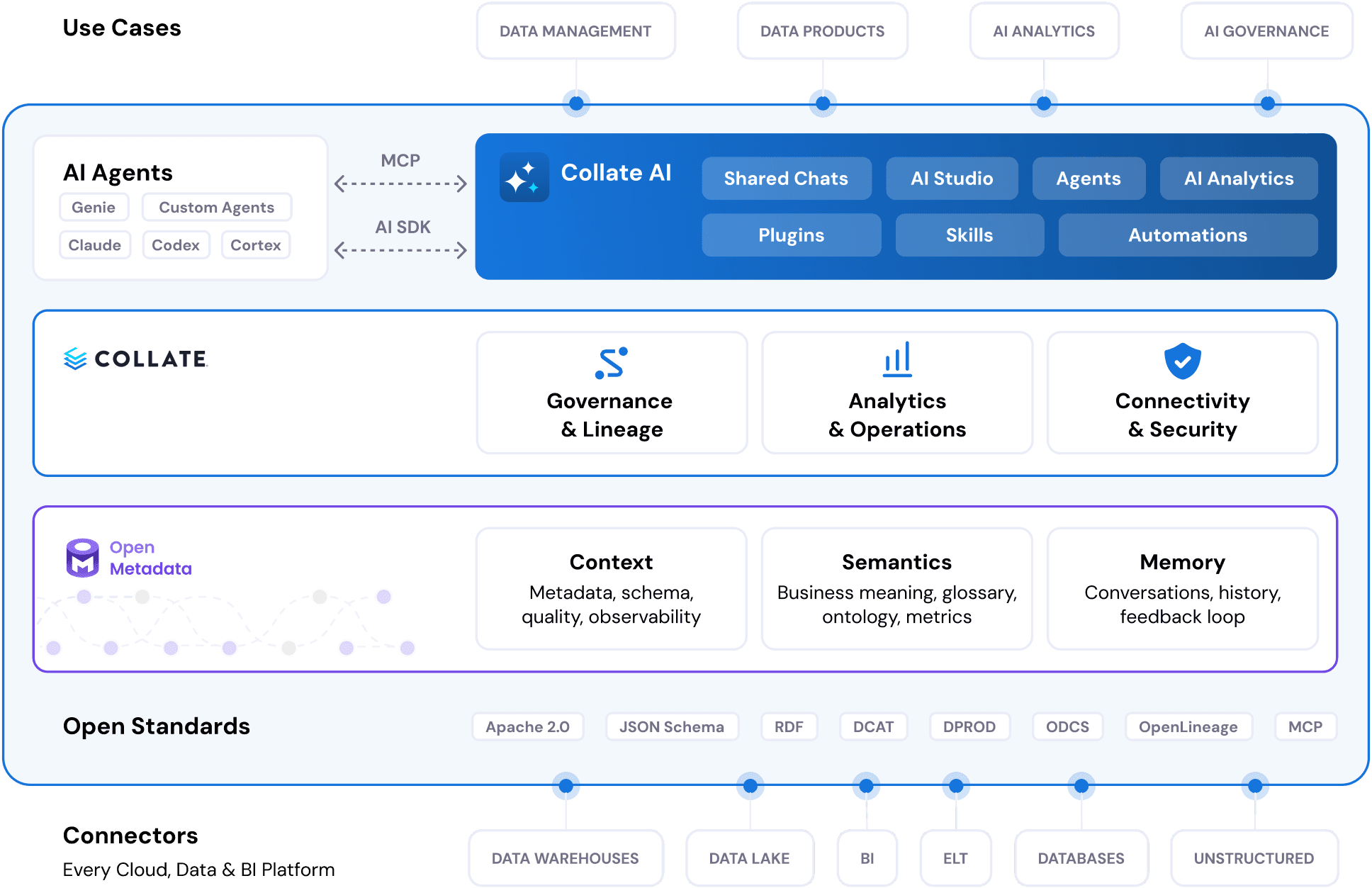
Collate is built on OpenMetadata, the open context layer that unifies technical context, business semantics, and organizational memory into one context graph — so AI agents and humans reason from the same trusted foundation. The architecture operates across three primitives.
1. Context
Collate maps every data source into a single open graph, connecting tables, columns, business glossary terms, metrics, dashboards, governance policies, lineage, and quality signals into one machine-readable layer built on open standards. Any LLM or agent framework that can read standard ontological representations can consume it directly, without proprietary transformation.
2. Semantics
Every Collate AI capability operates on that graph rather than on raw schema or column names. Collate AI Analytics resolves natural language questions to governed definitions before generating dashboards. AskCollate returns semantically correct assets rather than keyword matches. AI Studio and AI SDK power agents that automate documentation, quality, and governance workflows, with business criticality and governance obligations built in from the start. The Collate MCP Server extends that same governed semantic context to external LLMs and AI tools.
3. Memory
Every change made by a human or an agent is captured as a permanent, auditable record. Definitions compound rather than evaporate. Governance decisions made once propagate automatically to downstream assets rather than requiring manual re-tagging.

The Layer That Makes AI Trustworthy
AI does not create organizational alignment around data. It depends on alignment that already exists and is expressed in a form machines can traverse. Semantic context, built on open standards and encoded in a structured graph, is that expression. It is the difference between AI that reasons over governed meaning and AI that guesses from labels, and what makes self-service analytics, automated governance, and agentic workflows viable at enterprise scale. For organizations building an AI data governance strategy, that foundation has to be semantic, not just documented. That is what Collate is built to provide.